Street Resurfacing Program
Engineering Services
161 N Ross St
-
(334) 501-7390 -
webengineering@auburnal.gov -
- M-F
- 7:30AM-4:30PM
-
\t\t\t\t{{SocialMediaLinks}} \t\t\t \t\t

The City of Auburn has a Five-Year Resurfacing Plan to maintain public streets. The plan is based on data from road assessment surveys conducted by a third-party specialist. Our goal is to protect and extend the life of public streets through careful planning while maintaining the highest standards and reducing overall long-term costs of managing the Auburn street system.
Assessing Auburn’s Roads
Every 3-5 years, the City hires a consultant to survey all publicly maintained streets in the city limits. With specialized equipment and technologies, the consultant drives every road to check pavement conditions and collect imagery and data. This information is used to generate a pavement condition index (PCI) for each road segment, and the PCI is provided to the City along with a cost estimate for suggested repair and maintenance.
The PCI and street classification are used to rate the condition of each street and rank them for priority of resurfacing and other maintenance. Classifications are based on road usage and include arterial, collector and residential collector roads. Arterial roads have the highest traffic volumes, with examples being College Street, Gay Street, Donahue Drive and Glenn Avenue. Examples of collector roads are Magnolia Avenue and Thach Avenue. Busier streets are at risk of declining faster and would cause more problems if they were to fail. The overall score helps the City prioritize which streets need the most attention. That information guides the Five-Year Resurfacing Plan and the City budget.
View a map of the current Five-Year Resurfacing Plan.
Preventative Maintenance
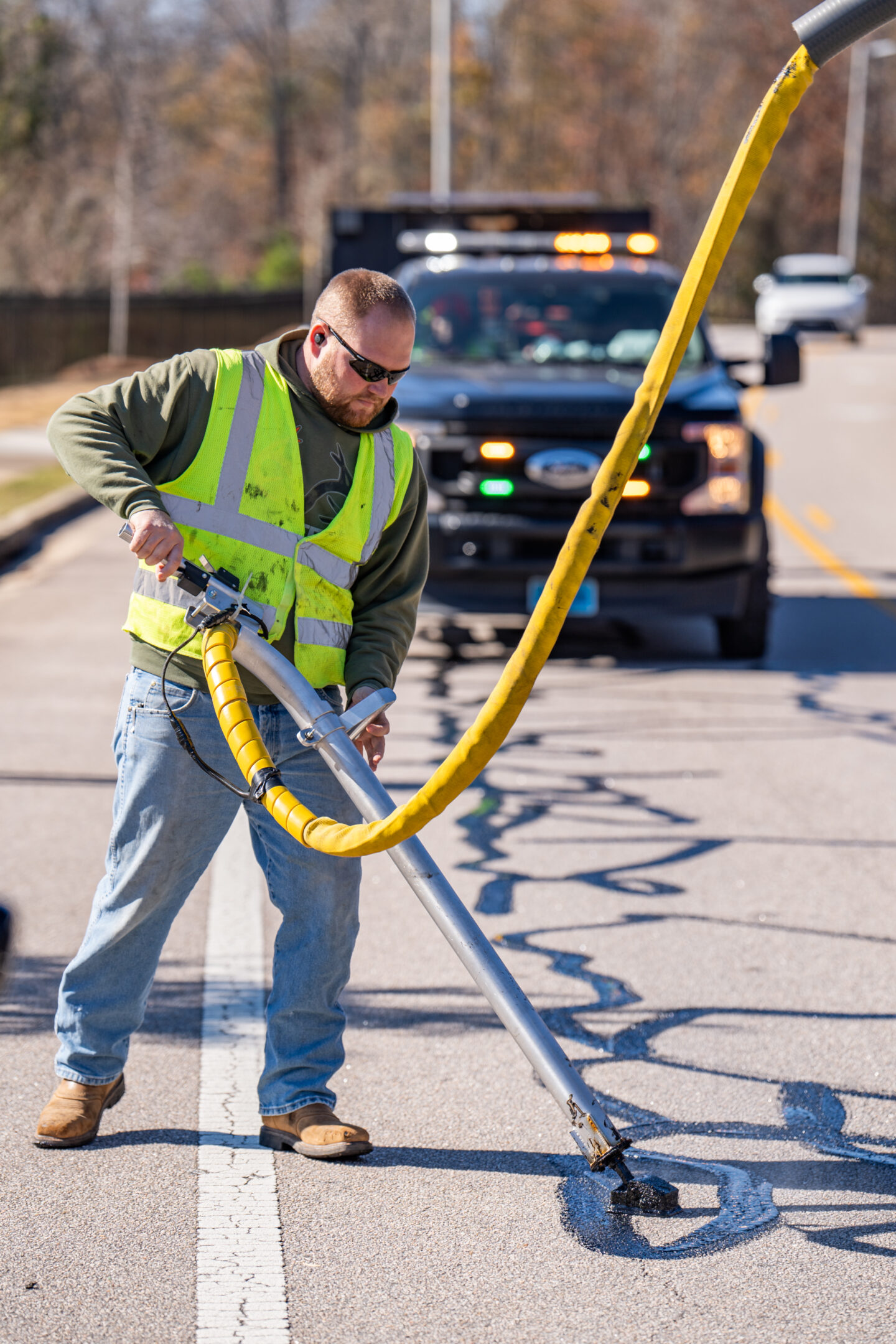
Analyzing Auburn's roads helps us create a resurfacing plan and get ahead of road failure. Two preventative maintenance methods we utilize to extend the life of our streets are:
Crack sealing: A cost-effective treatment that consists of applying a highly elastic material into pavement cracks while the pavement is still in good condition. This keeps out water and debris, protecting the pavement from further damage and extending its life.
Patching: A repair method to fix damaged pavement in a localized area. Damaged pavement is removed, the area is cleaned, and new asphalt is laid down. Patching is a quick, cost-effective way to fix potholes or cracked areas; however, it may not be the right method for more extensive pavement issues.
Notice an area of road that needs attention? Report any pavement issues in the Auburn FixIt app.